

Governance Proposals Dominate the 2026 Proxy Season
As the 2026 U.S. proxy season draws to a close, both the volume of shareholder proposals brought to a vote and the level of investor support they received show a dramatic change from previous years in the shareholder proposal landscape.
Early in 2025, the SEC issued Staff Legal Bulletin No. 14M (SLB 14M), revising shareholder proposal framework and providing issuers greater flexibility to obtain no-action relief. This change had a significant impact during the 2025 proxy season, greatly increasing the number of proposals being omitted from the ballot. The shareholder proposal landscape was further upended ahead of the 2026 proxy season, with the SEC’s Division of Corporate Finance retreating from its traditional role as an arbitrator of shareholder proposals, declining to review or express views on most requests for shareholder proposal exclusions.
Shareholder Proposal Volume Falls to a Five-Year Low
Against these backdrops, the overall volume of shareholder proposals submitted and advanced to a vote has declined to a five-year low.
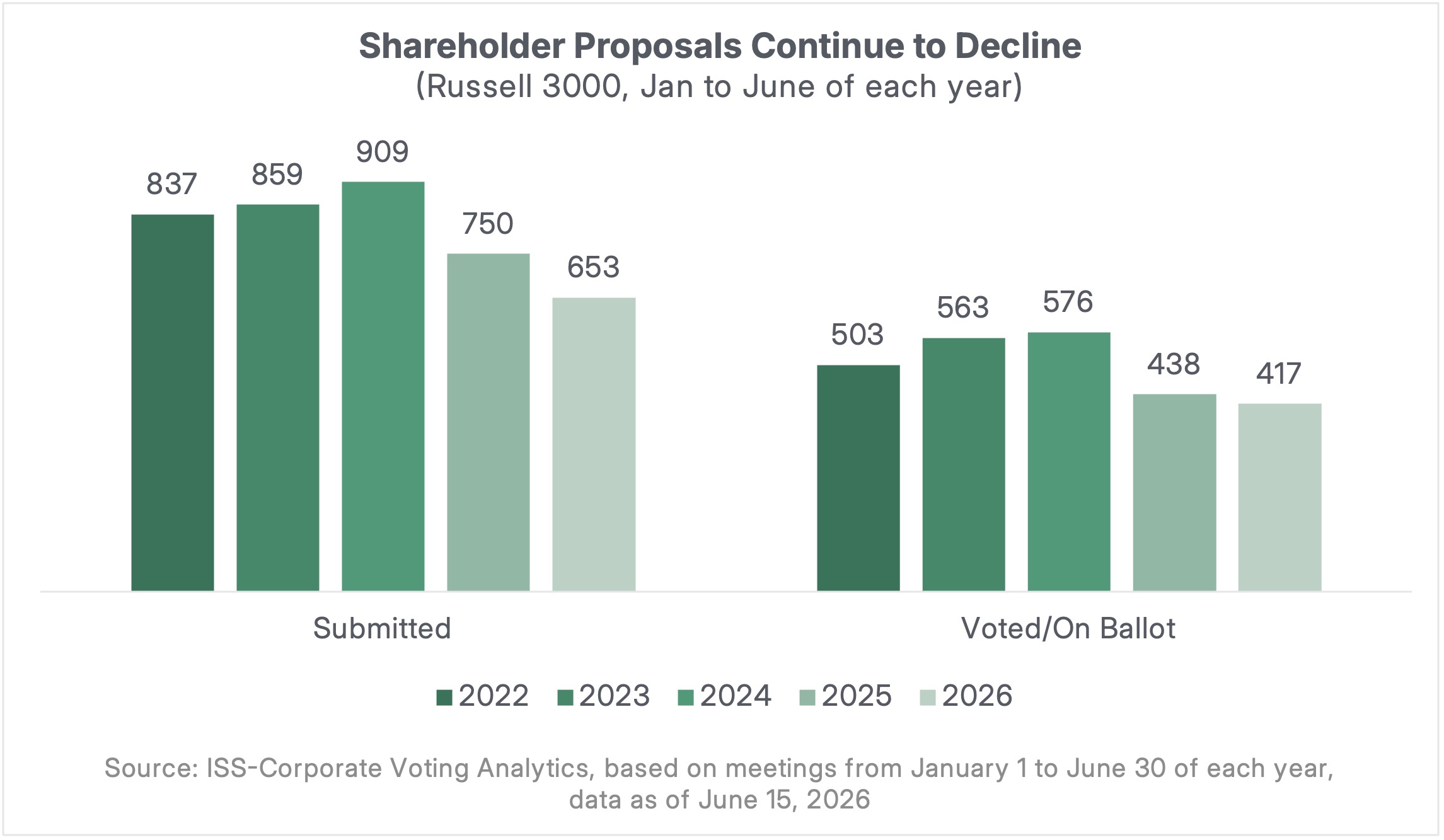
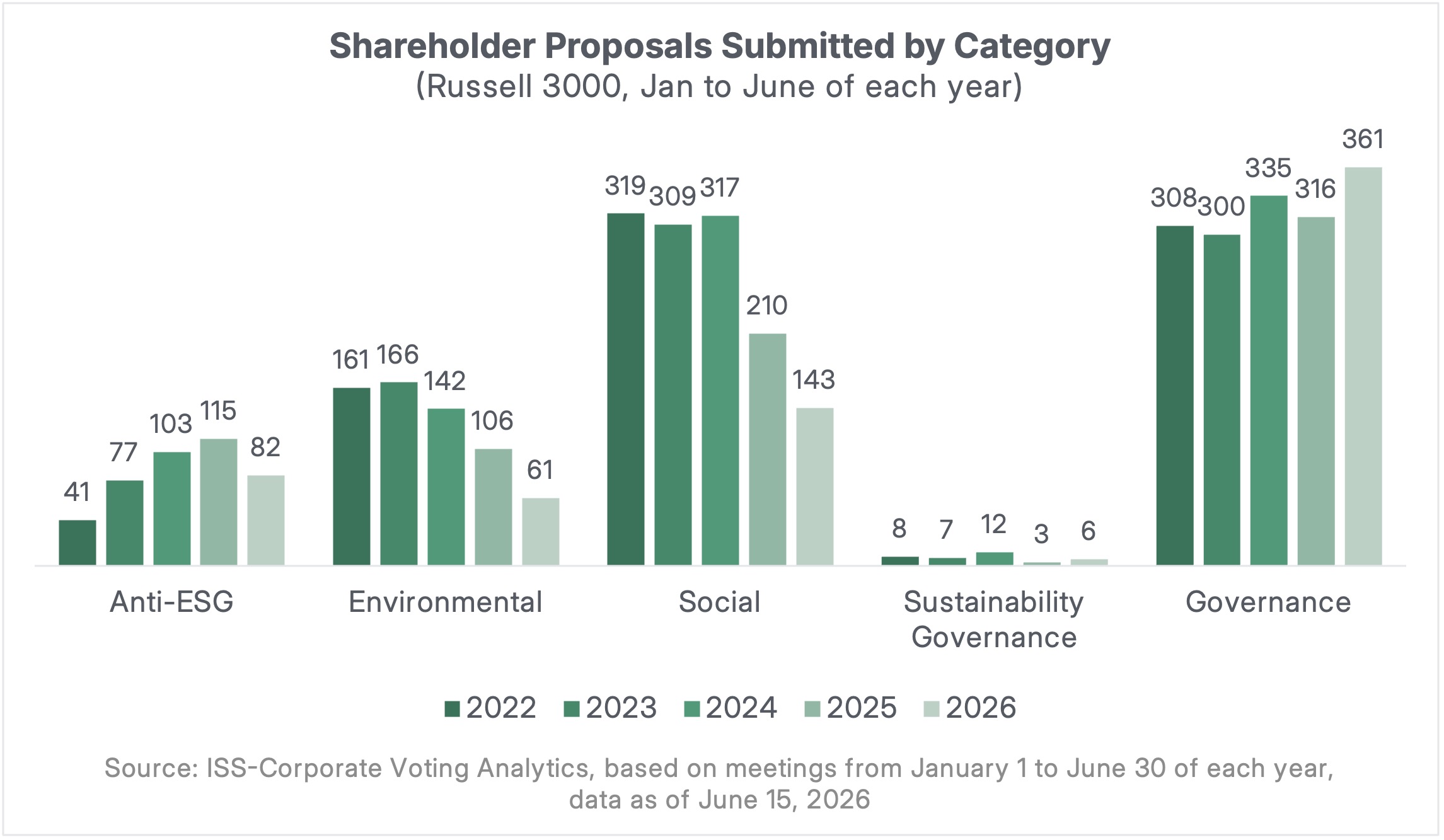
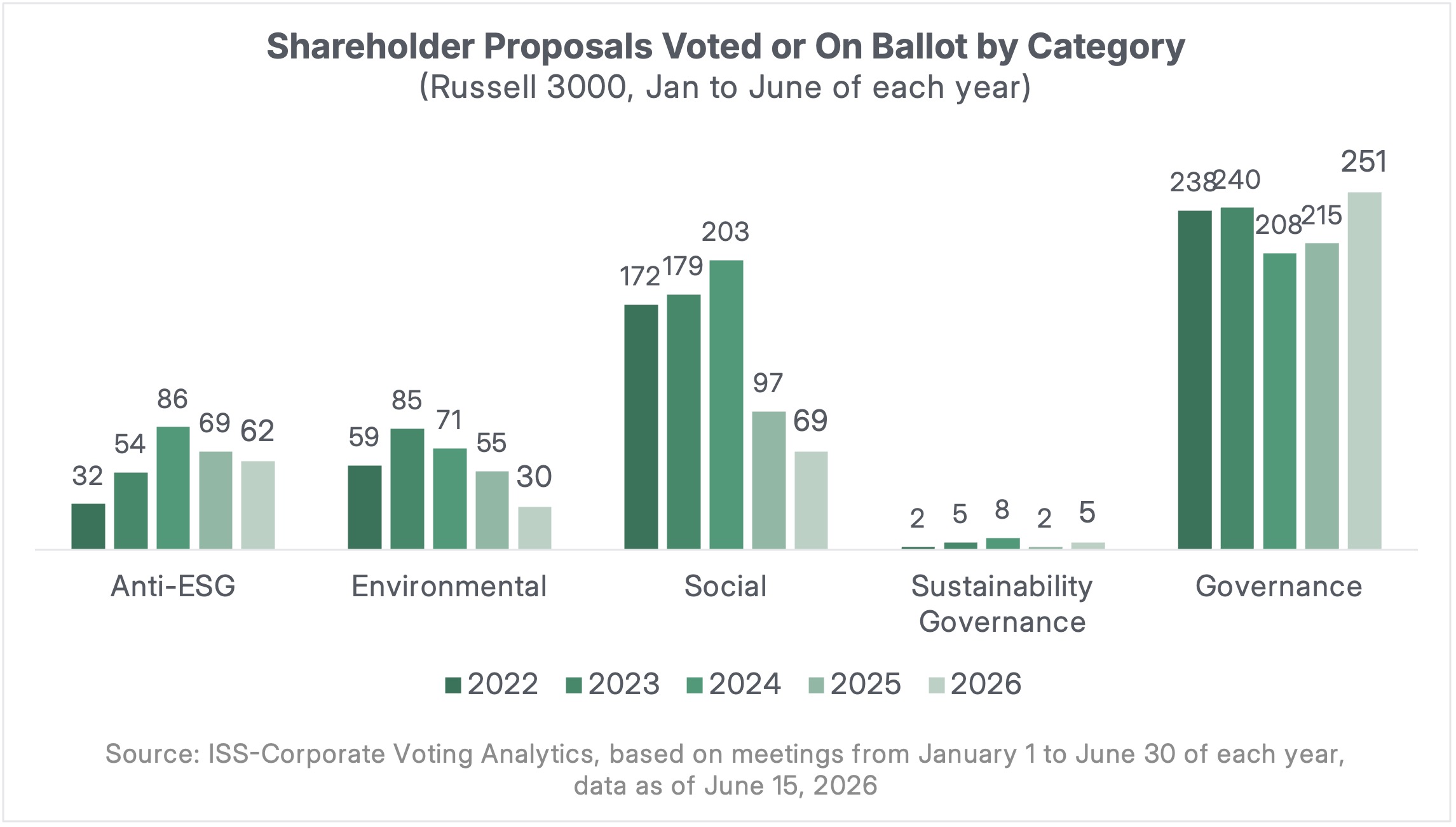
While the overall volume of proposal submissions and those appearing on the final ballot declined, governance-related proposals recorded an increase in overall volume. This relative resilience highlights the continued prioritization of core shareholder rights and board accountability mechanisms among investors as well as changes in proponents’ tactics.
In contrast, environmental and social proposals extended their downward trajectory with further declines in both the number of proposals submitted and proposals voted, reflecting a more selective investor approach toward these topics. Anti-ESG proposals, which had been rapidly increasing in volume, saw a decline as well, though they continue to comprise a meaningful portion of overall proposal volume.
The shift in proposal activity likely reflects a combination of factors, including the evolving political and regulatory landscape, the mixed success many environmental and social proposals have achieved in recent years, and the impacts of recent SEC actions.
Changes to the SEC’s shareholder proposal framework and no-action process appear to have altered the calculus for proponents, potentially discouraging some submissions while incentivizing others to pursue a more focused strategy. As a result, some proponents appear to have reduced proposal activity altogether, while others have become more selective in targeting issues and companies, or have redirected their efforts toward governance-related topics that historically receive broader shareholder support and face fewer ideological headwinds.
Taken together, these developments suggest that rather than signaling a diminished interest in environmental and social issues, the decline in proposal volume may reflect a strategic recalibration by proponents seeking to maximize impact and improve the likelihood of gaining meaningful shareholder backing.
How SEC No-Action Changes Reshaped Proposal Exclusions
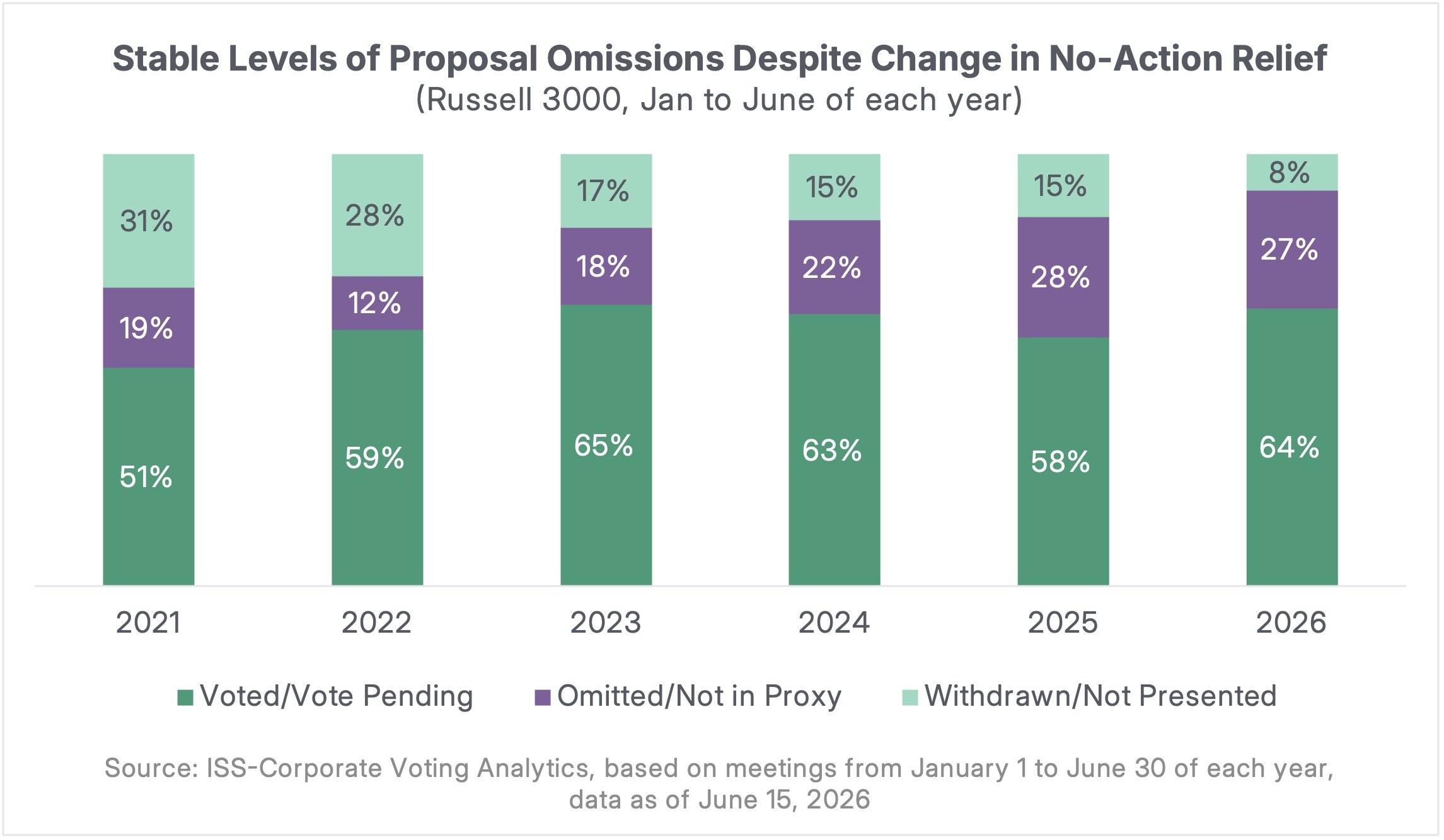
The SEC’s revised no-action process—under which the staff now issues “no-objection” responses rather than traditional no-action relief—significantly reshaped the shareholder proposal exclusion landscape and introduced greater uncertainty around the risks and consequences of omitting proposals. Faced with a less definitive regulatory framework and limited precedent, many issuers filing early in the season adopted a more cautious approach, opting to include shareholder proposals that might previously have been challenged through the no-action process.
As the season progressed, however, issuers became increasingly comfortable relying on exclusions, even amid a number of shareholder lawsuits seeking to contest proposal omissions. As a result, omission activity accelerated during the latter part of the season, and current trends suggest that the overall proposal omission rate is on track to closely mirror 2025 levels despite the procedural changes and heightened litigation risk.
Governance Proposals Earn the Strongest Investor Support
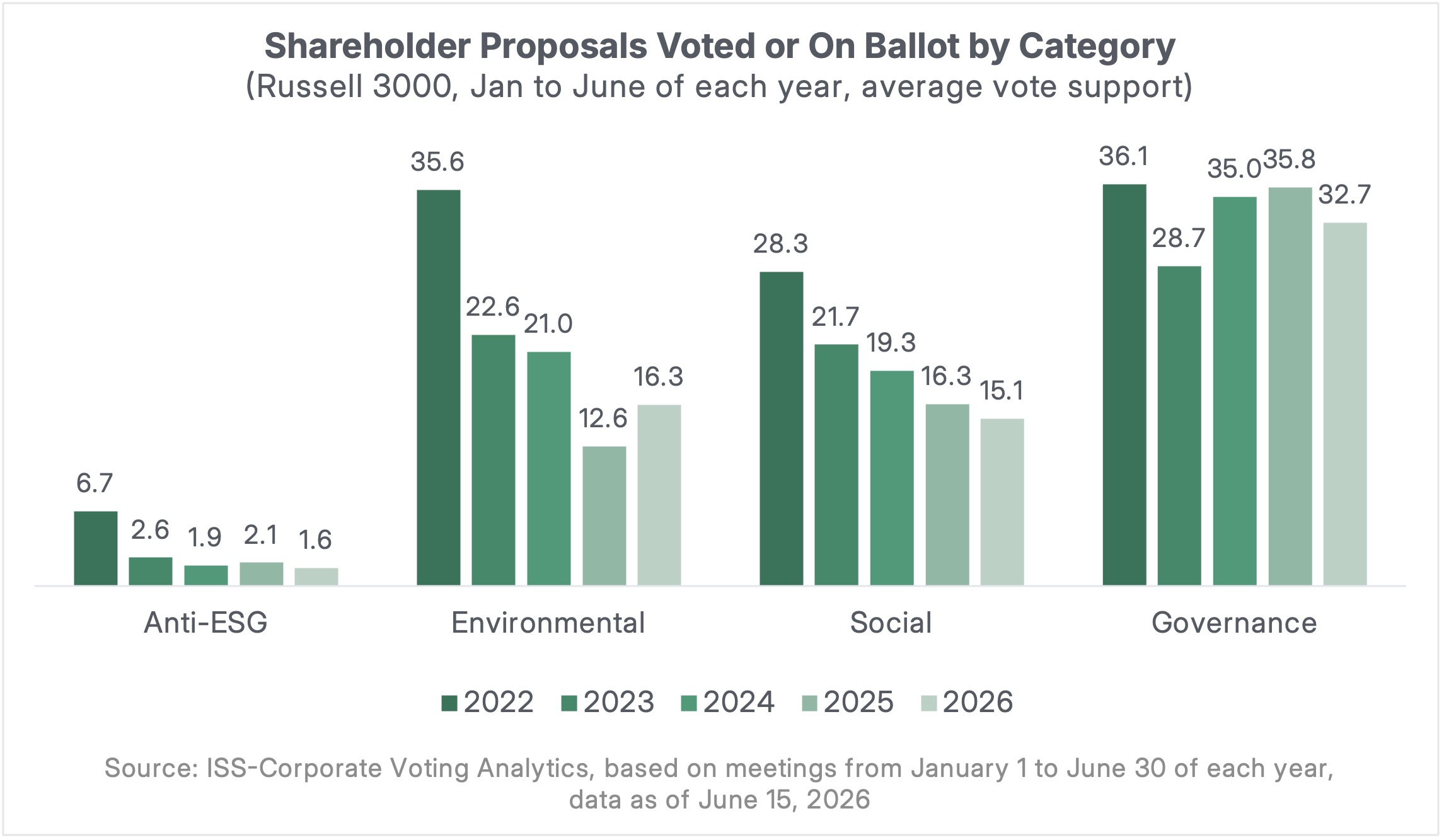
Among the proposals that made it to the final vote, governance proposals commanded the highest support levels, averaging 31.4% support in 2026 and significantly outperforming all other proposal categories despite a modest year-over-year decline. In contrast, environmental and social proposals continue to receive more varied and company-specific voting outcomes. Support on social proposals continued to erode, extending a multi-year downward trend and reflecting increased investor selectivity toward these topics. Meanwhile, anti-ESG proposals attracted minimal backing, garnering just 1.7% support in 2026 and remaining largely unsupported by shareholders despite increased visibility in recent years.
Environmental proposals were a notable exception. Despite experiencing the steepest year-over-year decline in volume, environmental proposals generated higher average support levels, suggesting that a smaller number of more targeted and strategically crafted proposals may be resonating more effectively with investors.
The vote support data highlights a growing divergence between governance proposals and other shareholder proposal categories and recalibration of investor priorities. While proposal volume declined broadly in 2026, investor support remained strongest for governance-related initiatives, underscoring continued shareholder focus on board accountability and shareholder rights.
Independent Board Chair Proposals Rebound in 2026
This proxy season, only governance-related proposals have achieved majority shareholder support to date, underscoring the recalibration of investor priorities to core shareholder rights and board accountability mechanisms. Independent board chair proposals, which were the most prevalent shareholder proposal category in 2026, experienced a significant resurgence in volume following two years of declining activity. The number of proposals voted increased to 70, up from 29 in 2025 and approaching the 2023 peak of 83 proposals, indicating renewed shareholder focus on board leadership and oversight structures.
Despite considerable fluctuations in proposal volume, investor support remained remarkably consistent throughout the period, averaging approximately 30% each year and rebounding to 31.8% in 2026, matching the level recorded in 2022. This stability suggests that shareholder views on the merits of an independent board chair have changed little, even as filing activity has varied significantly.
While independent chair proposals rarely secure majority support, the combination of rising proposal volume and sustained support indicates that board leadership structure remains a core governance priority for investors. In fact, prevalence of independent board chairs has been increasing steadily, with nearly 40% of S&P 500 companies having an independent board chair this year.
Shareholder Rights Proposals Continue to Win Investor Backing
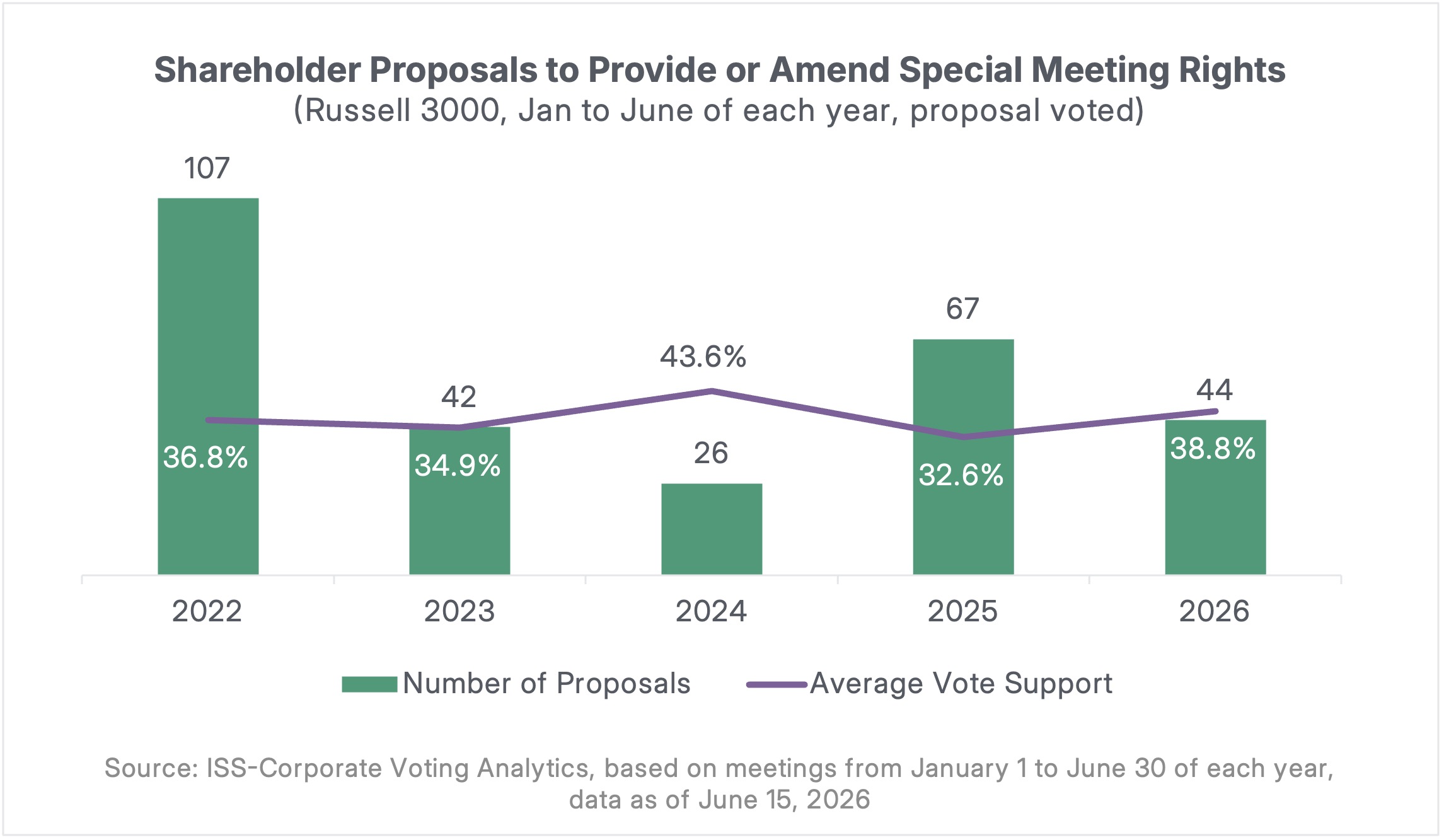
Proposals to adopt or amend special meeting rights ranked as the second most prevalent shareholder proposal category in 2026, despite a meaningful decline in overall volume compared to the prior year. This reduction in activity likely reflects the increasing adoption of special meeting provisions across the broader market, thereby shrinking the pool of companies without such rights.
While average vote support increased relative to 2025, it remains largely consistent with historical norms, underscoring continued and broad-based investor support for reasonable shareholder access mechanisms. In particular, proposals that seek to establish or lower thresholds to market-standard levels continue to garner strong backing, reflecting investor preference for balanced frameworks that enhance accountability without introducing undue governance risk.
ISS-Corporate’s Approach to Proxy Season Insight
The 2026 proxy season highlights significant changes in shareholder proposal activity. While overall proposal volume declined, governance-focused proposals remained resilient and continued to receive the strongest investor support, highlighting sustained shareholder focus on board accountability and shareholder rights. Meanwhile, environmental and social proponents appear to be recalibrating their tactics, adopting a more targeted approach.
As the 2026 proxy season concludes, these trends offer important signals about evolving investor priorities and the issues most likely to shape shareholder engagement and voting decisions in the years ahead. ISS-Corporate’s Compensation & Governance Advisory team helps companies analyze shareholder proposal trends, benchmark governance practices against market expectations, assess potential areas of shareholder concern, and develop engagement and disclosure strategies that align with investor priorities. Through data-driven insights and practical governance guidance, we support boards and management teams in preparing for future proxy seasons and strengthening shareholder relationships in an increasingly dynamic governance landscape.
Legal Disclaimer:
EIN Presswire provides this news content "as is" without warranty of any kind. We do not accept any responsibility or liability for the accuracy, content, images, videos, licenses, completeness, legality, or reliability of the information contained in this article. If you have any complaints or copyright issues related to this article, kindly contact the author above.
